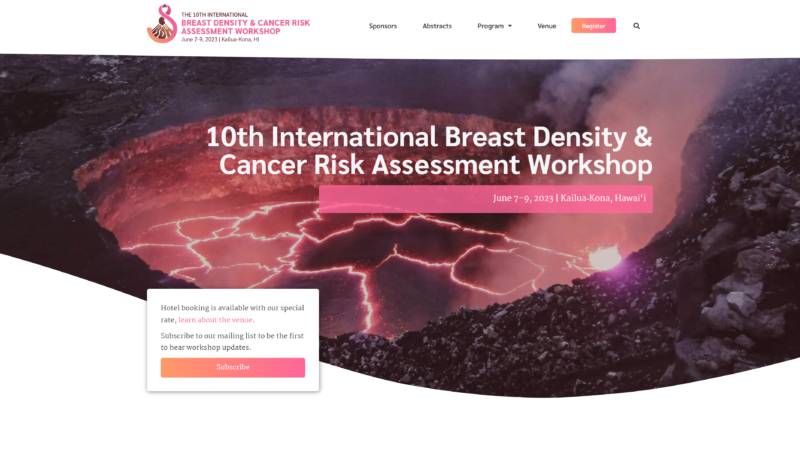
Planning an academic conference can resemble launching a product. Each session, abstract submission, and networking opportunity functions like a feature that must work together to create a cohesive experience. While managing the International Breast Density & Cancer Risk Assessment Workshop (IBDW) in 2023 and 2025, I approached conference planning through the same lens I use in product work: structured planning, iterative updates, and constant attention to the needs of the people using the system.
As program manager, my role spanned scheduling, logistics, communications, marketing, and operational planning. The goal was to coordinate a complex event while ensuring that attendees experienced a smooth and well-organized conference.
Background
IBDW is an international academic workshop focused on breast density and cancer risk research. The event brings together clinicians, researchers, and public health professionals to present research findings and collaborate on emerging scientific questions.
Organizing the workshop required coordinating many moving parts. Speakers, abstract submissions, venue logistics, travel coordination, networking events, and communications all needed to align on a shared timeline.
Because many participants attend from around the world, disruptions or confusion in planning can quickly affect the attendee experience. Even small issues—such as unclear schedules or last-minute changes—can create friction for participants who are navigating unfamiliar environments.
The challenge was creating a planning process that could handle complexity while remaining flexible enough to absorb unexpected changes.
Challenge
From the start, I approached conference planning as a system rather than a collection of individual tasks. Instead of treating each responsibility independently, I structured the work similarly to a product roadmap.
The goal was to maintain visibility into the entire event at all times. Chairs and committee members needed to quickly understand what had been completed, what decisions were pending, and what tasks were approaching deadlines.
Flexibility was equally important. Conferences are inherently unpredictable. Speakers cancel, schedules shift, and logistical constraints emerge as planning progresses. A rigid plan would quickly become outdated, so the process needed to support iteration and contingency planning.
Process
The central planning tool for the workshop was a shared Google Sheet that functioned as a living roadmap for the conference. Major responsibilities such as venue coordination, abstract management, communications, and marketing were broken into smaller tasks with assigned owners and deadlines.
After each bi-weekly planning meeting, I updated the document with decisions, new ideas, and adjustments to timelines. This allowed the chairs and organizing committee to see the overall status of the conference at a glance.
The system also helped manage unexpected challenges. For example, when a speaker canceled shortly before the 2025 workshop, I prepared multiple revised agenda options while waiting for the chairs to confirm a replacement. Having a clear structure in place made it possible to adjust quickly without disrupting the overall schedule.
Another logistical challenge emerged during the 2023 conference in Kona, where transportation and venue space limited the number of attendees who could participate in certain activities. To address this, we coordinated several simultaneous networking activities that concluded at the same time, allowing all participants to reconvene for the evening reception.
In addition to planning logistics, I expanded the internal documentation system for the conference. The existing Google Drive folder was reorganized to include promotional materials, planning documents, email threads, and meeting notes. This created a single source of truth where team members could quickly locate information without needing clarification from others.
Final Product
The result was a structured planning system that supported collaboration across chairs, committee members, and staff.
Because the planning process maintained a clear overview of the conference at all times, the team could adapt to changes without losing momentum. Communication remained transparent, responsibilities were clearly tracked, and planning decisions were documented in a way that allowed the entire team to stay aligned.
The system also improved continuity between workshops by preserving documentation that could be reused and refined for future events.
Impact & Insights
Each workshop faced different external challenges. The 2023 event took place during the uncertain recovery period following the COVID-19 pandemic, while the 2025 workshop occurred during a time of federal research funding cuts that affected travel budgets.
Despite these challenges, both workshops were successful. Attendance remained strong, abstract submissions grew from approximately fifty in 2023 to around ninety in 2025, and participation in networking events roughly doubled.
This experience reinforced a principle that applies equally to product design and project management:
Complex systems become manageable when work is visible, structured, and adaptable.
By approaching the conference as a coordinated system rather than a series of isolated tasks, the planning process remained flexible while still maintaining clear direction.